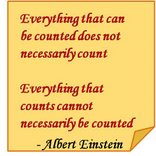
Last month, I wrote to a few people I know who are research buyers / consumers about what they expect from qualitative research and researchers. The one thing that I read repeatedly through many of those responses was that :
Researchers ought to have an understanding of the BIGGER PICTURE....an appreciation of what is the research being done for...how will it impact the client's business, what are they trying to achieve through the research, have an understanding of the dynamics that prevail in the industry that your client's operate in!
Flip the side of the coin and you find that client briefs (at least in India) tend to be skeletal at best and researchers lament about not being given the business backdrop against which the research is being planned...about not being given enough time or opportunity to discuss why the research is being done...or how the information gathered through research would be used...what sort of a decision would it help the client take ?
As a researcher I have felt frustrated at being told only half the story and sometimes not even that, though when I stepped back and thought about this issue, it seemed a little ironical - how, both the client and the researcher expect the same thing from each other - and yet many a time - there remains a large gap in communication and in the understanding of the BIGGER PICTURE.
At about the same time I was thinking about this, I happened to read Dr Sheila Keegan's article - Emerging to a brave new world.
Problem Definition - outside of the research process
Amongst other things, on page 3 she talks about one of the possible reasons for this gap -
That 'problem-definition' has not always been considered part of the research process. She goes on to say...
"From a researcher perspective, this area is fraught. Historically the client defines ‘the problem’. But, from a process consultant perspective, the client ‘often does not know what she is looking for and indeed should not really be expected to know’ (Schein, 1999). A change of expectations and working relationships between clients and researchers is needed before problem definition is widely accepted as a valid research area."
Vendor v/s Stakeholder
The other reality to this issue is that historically research agencies (unlike advertising agencies who have has always enjoyed the status of a stakeholder to a brand) have been looked at as mere vendors. With brand managers often been given new portfolios every few years and advertising agencies not always retaining their accounts, sometimes the research agency de facto becomes the reservoir of knowledge on a brand, yet suffers from the perception of being considered an 'outsider'
Implicit expectation from the researcher
My last hypothesis on this issue is that maybe...just maybe client's implicitly 'expect the researcher to have and active understanding of their business and therefore expect the researcher to ASK the questions that would clarify the business objectives relevant for research. The onus is then on the researcher to seek or clarify the research brief.
Whatever be the reason, there is no debate on the fact that it is imperative to the efficacy of research that the business context be understood - if as a researcher you are not handed down that knowledge on a platter, may be you just got to try harder.
Thanks to Christine, Neil, Poor_Planner, Naveen & Saurabh for contributing their thoughts on the subject !
Aug 1, 2007
On why researchers do not appreciate 'the bigger picture'
Posted by
Reshma Bachwani
at
3:40 PM
2
comments
Jul 23, 2007
Flavor of the season – treating research tools as buzzwords
Creeping back into the routine of reading blogs, I chanced upon Mack’s post on - Walking the Social Media utility/hype line in which he talks about the ‘hot toy (tool) of the week’ in the social media space.
Much of what he says about new tools in the social media sphere is so true of qual research as well.
Still, if you listen to some in the blogosphere, it seems that the shine has worn off blogging. Blogs are quickly becoming yesterday's news, as some run off to play with shinier toys with names like 'Facebook', 'Pownce' and 'Spock'. That's because we geeks love to hype stuff (and bloggers know that if they are hyping the hot new toy, they'll get more traffic).
At one time it was (& perhaps still is) fashionable to talk about the death of focus groups in research circles and the shift from ‘conversation led’ research to ‘observation-led’ research. Ethnography dominated the scene for a while as the flavor of the season, and before we knew it the next big thing to happen in the world of Qual was online research. For a while there were talks about doing online focus group sessions in live chat-rooms, but before we could digest that fully we started talking about Blogs, wikis & setting up research panels on Second Life.
So where in lies the problem? The problem is not with keeping an open mind to methodological experiments. The problem is when research agencies especially small – new outfits start looking at these methodologies as their differentiating tools. Then the method over-rides any other consideration while planning a research and there is a blanket adoption for a pet method. Also since method becomes a differentiating factor, there is tendency to safeguard one’s method by putting it into a ‘black-box’ of sorts and presenting it to the world in the form of obscure, jargon-laden decks of power-point slides. Talking to another researcher-blogger, about this issue – we wondered how this was so not in keeping with the spirit of research – which is to throw light on issues and not obfuscate them under the guise of esoteric methodologies.
The other problem is that when follow these flash trends, we start treating research tools as ‘buzzwords’ – and we implicitly give these tools very little time to prove their worth in research. While they are in vogue, they are used indiscriminately and once they are out (possibly because of a few sub-optimal attempts at their use), nobody likes to talk about them. Very little is done to understand the right context for their use, or develop those into more robust approaches.
Mack’s concludes his post with the thought…
…..Believe the utility, not the hype. Jumping from one 'next big thing' to the next, simply leaves you with tired legs. Any new site/service/medium that offers real value will outlive the initial buzz.
And I second that!
Posted by
Reshma Bachwani
at
12:22 PM
3
comments
Labels: Research Methods
Jun 13, 2007
'2.0' phenomenon in the real world
I'm sure this video is going to be doing the rounds of blogs for a few more days before we forget it. It was interesting to see the adaptation of the Web 2.0 concept in the real world. Going beyond the humor...many of those situations are workable
User comments on products...we see this happening in book stores where people who have read certain books, leave behind their comments for others to see.
Refreshing names for product variants...specially for low involvement products - 'quality time', 'tickling', 'better audio' - definitely catches more attention for ear buds than labelling those by size / softness
'Most popular' lists for a category ...reminds me of conversations i have overheard at the supermarket - people standing in the same aisle...looking at the same product category consult each other with suggestions on which brand to buy. Putting up a list of the fastest moving product variants / brands - could aid undecided shoppers zero-in on their purchase.
Predictive shopping...if you are buying Olive oil and pasta sauce - then you surely may be in need of dried pasta or oregano. Reminder tags placed where these products are stocked or pop up messages at the self service check outs is not too distant a possibility
RSS feeds from producers :)...this is already underway in a small way. I get a newsletter from 'Innocent' that tells me (amongst other things) - the new product variants that are on offer or are being planned.
Consumers who spend a great deal of time online and are already familiar with these concepts - would welcome seeing them in a 'real world' environment. For others - many of these ideas if implemented would mean an important step taken by a retailer to cut down the time and energy wasted on decision making in a cluttered environment.
I am going to mull on this for while...meanwhile if you have any thoughts on more adaptations of the 2.0 concept in the real world ...drop in a line.
Posted by
Reshma Bachwani
at
1:14 PM
2
comments
Labels: Food for thought, Social Media, Zeitgeist
May 25, 2007
Us v/s Him - Treatment of Outliers in Qualitative Research
I read this post on Helen's blog some days ago, that set me thinking. Is there a subconscious bias prevalent within the discipline of qual research - a bias that favors the majority such that we lay greater emphasis on the thoughts expressed by 'many' vis-a-vis those expressed by a 'few'?
There are two reasons I could think of - about why this could happen
1. An external bias (from the client)
Even though in the recent past people have begun to appreciate the kind of information that qualitative research brings to the fore - it is still, often judged by the same yardstick as is used in case of quant research. How many times have we heard clients challenge findings by asking questions like...can you tell me how many people felt that way and the researcher diffidently admitting...well, there were just a few. To which one would hear...well then lets not give it too much importance and move on...Why does this emphasis on numbers infiltrate qualitative studies as well? Is that the only metric by which the worth of something can be judged ? What makes people so easily believe that the view point expressed by 'one' or a 'few' is a not a thought worth pursuing ?
I suppose repeated exposure to this way of thinking could lead researchers to start questioning their own beliefs such that the next time one is faced with a stray thought like that - rather than sounding shaky in front of a client, the researcher may nip it in the bud.
2. The other is the researcher's own bias
For long qual researchers have relied on the technique of 'story telling' to analyse and present findings. This helps the researcher see inter-connections in the data set such that she can look at the data holistically and understand the consumer's mind set i.e. where the consumer is coming from. It is also an effective way of communicating findings to the client - to narrate the findings in a sequence that ultimately builds up to the climax i.e. the insight !
But how does one treat a piece of data that does not fit in with one's beautifully crafted story? For a long time I would keep aside that piece of data, treat it as an exception - that is what I had initially learnt - filter it out - if it does not fit in with your story. It is much later I learnt that...If it does not fit in with your story....there must be a bloody good reason for it....so look at the data again...tap it gently from either side, sleep over it and you will eventually find out WHY!
I do not believe that every stray thought that one hears would definitely hide something significant under its skin. However, don't discard it or belittle it before giving it the attention it deserves. As Helen rightly puts it...
"An inconvenient little wobble in a research context, could mean something more significant in real life. I think we have a duty to report them. Carefully."
P.S - If you are used to thinking 'the more the merrier' - think again - more does not have to mean more number of people with single thought, it could also mean a few people with more number of thoughts
Posted by
Reshma Bachwani
at
4:18 PM
4
comments